When Should You Repair, Refurbish, or Replace a Passenger-Facing Asset?
When Should You Repair, Refurbish, or Replace a Passenger-Facing Asset?
FORT WORTH, TX — October 16, 2026 — A damaged passenger seat doesn’t automatically need to be replaced, and it also doesn’t always make sense to repair it again.
Knowing when an asset has reached the point where another repair is no longer the best operational or financial decision is the harder question.
After working with thousands of high-contact assets in busy passenger environments, we’ve learned that the answer usually isn’t found by looking at the current damage alone.
That is why the decision to repair, refurbish, or replace should start with understanding the asset, not just the current issue.
1. Start With the Current Condition
What is actually wrong with the asset?
Some issues can be addressed with a relatively simple repair. A damaged component may be replaceable while the rest of the asset remains in good condition.
Other assets may show broader wear after years of heavy use. The underlying structure may still have significant useful life even though upholstery or individual components need attention. In those cases, refurbishment may offer an alternative to full replacement.
The important distinction is that visible wear does not always mean the entire asset has reached the end of its life.
2. Look Beyond the Current Repair
An individual repair only tells you what is happening right now, the asset’s service history provides the context.
Has this asset needed attention before? Is the same component repeatedly failing? Are repairs becoming more frequent?
The first repair and the fifth repair shouldn’t necessarily be viewed the same way.
When every service request is treated as an isolated event, patterns can be difficult to recognize. Connecting those events to the individual asset gives teams a clearer picture of how it is performing over time.
That history can help determine whether another repair still makes sense or whether it is time to consider a different approach.
3. Consider Whether the Asset Can Be Refurbished
There is a large space between a minor repair and complete replacement.
Refurbishment can allow facilities to restore existing assets while extending their useful life. Depending on the asset and its condition, this may include reupholstery, material restoration, component replacement, or other more extensive work.
This is especially important for assets such as public seating, where replacing an entire unit because of worn materials or a damaged component may not always be necessary.
Refurbishment can also help facilities maintain consistency across an existing environment rather than introducing replacement assets that may differ from what is already installed.
The question becomes less about whether an asset looks new and more about whether it can continue to perform as intended.
4. Understand What Is Happening Across Similar Assets
One asset can tell you something.
Thousands of assets can reveal a pattern.
If similar assets repeatedly require the same repair, the issue may be larger than an individual work order. The same can be true when certain components begin requiring more attention or when maintenance frequency increases across a group of assets.
Those patterns can help facilities better understand where maintenance resources are being used and where future needs may be developing.
They can also provide useful information for future purchasing decisions.
Maintenance data doesn’t only tell you how an asset has performed in the past. Over time, it can help inform what you purchase next.
5. Factor in Parts and Long-Term Support
Sometimes the condition of the asset isn’t what ultimately determines the decision, supportability does.
An asset may still be serviceable, but replacement components may become difficult to source. Certain materials may no longer be available, or continued repairs may require increasingly specialized work.
Understanding parts availability and the ability to continue supporting an asset should be part of the lifecycle decision.
This is also where relationships between facility teams, service providers, and manufacturers can become valuable. The more information available about the asset itself, the easier it becomes to understand what options remain before replacement becomes necessary.
6. Look at the Cost Over Time
The cost of today’s repair is only one part of the equation.
An inexpensive repair may make perfect sense for an asset that has otherwise required very little attention. The same repair may deserve another look if it is one of many performed on the same asset over a relatively short period.
This is where maintenance history becomes particularly useful.
When teams can begin asking what has it cost them to keep an asset in service, it provides a much better foundation for deciding whether continued repair, a larger refurbishment, or replacement is the most appropriate next step.
Making these decisions becomes difficult when information is spread across work orders, spreadsheets, emails, or individual team members.
That is one of the reasons AFS developed ALINK™.
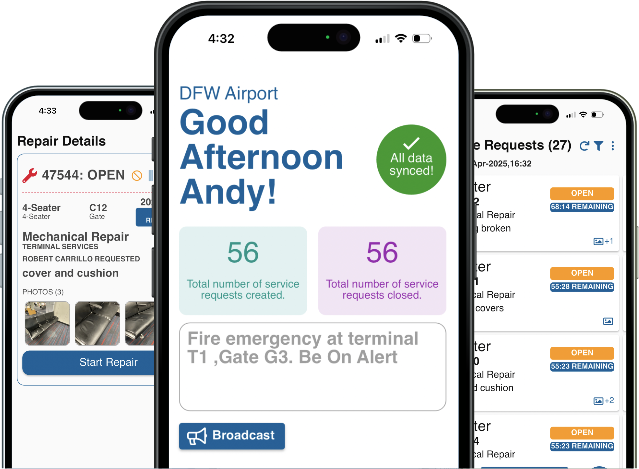
ALINK connects frontline activity to individual assets so teams can maintain a more complete record of what has happened throughout an asset’s service life. Condition information, location, photos, inspections, repairs, and service history can remain connected to the asset rather than disappearing when a work order is closed.
The goal is to provide the context needed to make better decisions.
A facility team looking at an asset shouldn’t have to rely only on what they can see today. Understanding where that asset has been and what it has required over time can provide a much clearer picture of what should happen next.
Passenger-facing assets experience constant use. Wear is inevitable, but wear alone doesn’t determine the end of an asset’s useful life.
Sometimes a targeted repair is all that is needed. Sometimes refurbishment can restore an asset and extend its service life. And sometimes history shows that replacement is the more practical decision.
The important part is having enough information to know the difference, that is where better asset visibility starts turning into better lifecycle decisions.
Other Resources


Ready to See ALINK™ In Action?
Discover how operational visibility can transform your facility’s performance.