Why Airports Manage Escalators Better Than Seats
Why Airports Manage Escalators Better Than Seats
FORT WORTH, TX — July 9, 2026 — There are certain things every airport knows, such as an HVAC system failing or a baggage belt going down. Because these systems are monitored, maintained, and managed, someone always knows about it. All airport staff understand that they are critical to airport operations.
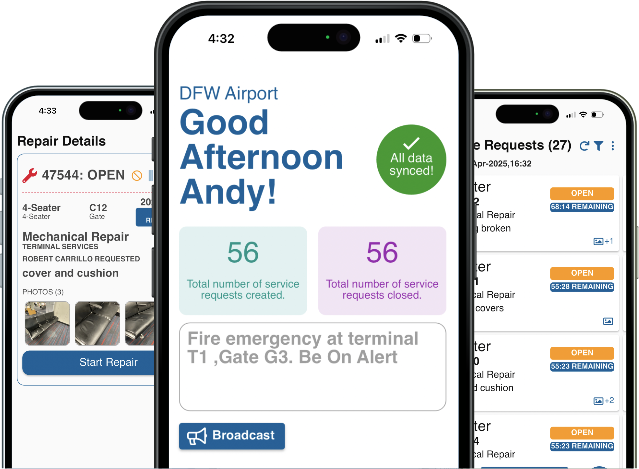
When thinking about passenger seating, how many seats are in your airport and how many need repairs today? Which of those have been repaired three times in the last two years? Do you know which manufacturer is performing best, or which gate has the highest concentration of damaged seating? For many airports, those questions are surprisingly difficult to answer due to passenger-facing assets being traditionally managed differently.
These assets have always occupied an interesting place in airport operations. Passengers use them constantly, and everyone notices when they’re damaged, yet they’ve rarely been treated as an operational system. Instead, they are often managed one work order at a time. That’s one approach. In fact, it’s kept airports running for decades. It also means we’re solving individual problems without always understanding the bigger picture.
Imagine walking into your garage every morning and fixing whichever tire happened to be flat that day. Eventually every tire would get repaired, but you’d never stop to ask why one tire keeps failing or if there was a systemic issue causing the individual failures. Now imagine doing that for a whole fleet of vehicles and thousands of tires. We often lose sight of the system when we focus only on individual repairs.
Passenger-facing assets are a system because they’re connected operationally. Every seat, every charging station, every waste receptacle, every water bottle filling station, and every information kiosk contributes to the experience passengers have inside the terminal. One damaged seat is an inconvenience, but hundreds of worn or broken assets across multiple concourses begin to shape how passengers perceive the airport itself.
Over the years, we’ve learned something that continues to surprise people. The repair itself usually isn’t the difficult part. The difficult part is knowing where to spend your time.
The good news is that airports already know how to manage complex operational systems; they’ve been doing it for decades. The opportunity now is to apply that same way of thinking to the assets passengers interact with every day. Together, these assets represent one of the largest, most visible parts of the passenger experience.
The conversation shouldn’t begin with, “How do we repair another seat?” It should begin with a different question.
How can we start to manage individual assets as a system?
That’s where better decisions begin.
Other Resources




Ready to See ALINK™ In Action?
Discover how operational visibility can transform your facility’s performance.