Did Everything Get Inspected?
Did Everything Get Inspected?
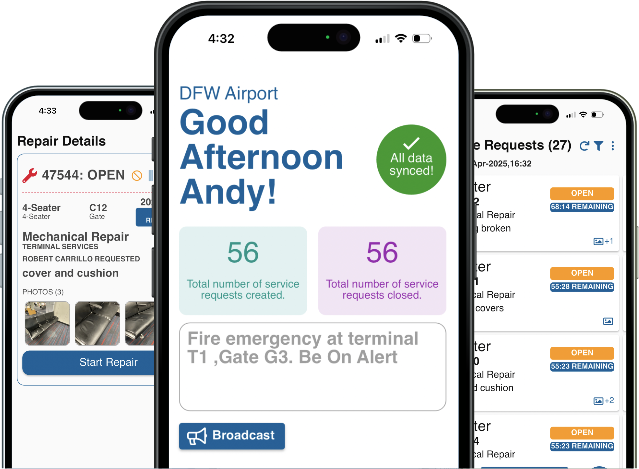
FORT WORTH, TX — October 23, 2026 — Most large facilities have things that need to be inspected or serviced on a regular schedule. It might be 5,000 seats across an airport, hundreds of fire extinguishers across a large facility or campus, or 100 restrooms spread across a national park. The assets are very different, but the operating challenge really isn’t.
Someone has to find each one, inspect or service it and move on to the next. The larger the number and the more ground there is to cover, the harder it becomes to answer a pretty simple question. Did everything get done?
Saying Concourse B was inspected isn’t necessarily the same as knowing every seat was inspected. Saying the fire extinguishers were checked doesn’t tell you whether one was missed. Saying park restrooms were serviced doesn’t tell you whether one at a remote trailhead was missed.
That’s where starting with a list you can reconcile against the work completed changes things. If 5,000 seats are due for inspection, start with 5,000. The same applies whether it’s 500 fire extinguishers or 100 park restrooms.
As each one is completed, the list gets smaller. Inspect a seat, check a fire extinguisher or service a restroom and it’s off the list. What remains may be the most useful part.
If 98 restrooms were serviced, that might still have been a perfectly acceptable day. But which two weren’t? If 499 fire extinguishers were checked, where is the last one?
Maybe something was inaccessible, moved or simply couldn’t be completed. Now we all know what still needs attention instead of assuming the entire area was covered. More importantly, we know exactly what we’re looking for.
But completing the list is only part of the value. What was found should stay connected to the individual asset or location. A damaged seat, an extinguisher that needs attention and a problem in a remote park restroom are very different issues, but the questions aren’t.
Who was there? When were they there? What did they inspect or service? What did they find? What happened next?
Over time, those activities become history. Now we know when something was last inspected, what was found, what work followed and whether the scheduled cycle was completed. We may also begin seeing recurring problems that aren’t obvious when each visit stands alone.
The type of asset doesn’t really change the challenge. When there are a lot of them, a lot of ground to cover and a recurring responsibility to inspect or service each one, we need to know what’s been completed and what’s still out there.
And we shouldn’t have to wait until the end of the day to find out.
We should be able to know in real time what’s been completed, who completed it, what they found and what’s still on the list. Then tomorrow doesn’t have to start with an assumption about what happened today.
Other Resources


Ready to See ALINK™ In Action?
Discover how operational visibility can transform your facility’s performance.