USB-A Charging Ports: The 1,500 Plug-In Problem
USB-A Charging Ports: The 1,500 Plug-In Problem
As airport charging infrastructure continues to grow, it may be time for our maintenance practices to evolve alongside it.
Over the past decade, airports have made tremendous investments in improving the passenger experience. One of the most visible has been the expansion of charging-enabled seating, workstations, and standalone charging stations throughout our terminals.
According to the International Air Transport Association’s (IATA) Global Passenger Survey, nearly eight in ten travelers expect their smartphone to be at the center of their travel experience. As airlines continue expanding the use of digital boarding passes, mobile notifications, and app-based passenger services, reliable charging has become an increasingly important part of the airport experience.
Across approximately 500 U.S. commercial airports, an estimated 500,000 gate-hold seats support more than 853 million passenger journeys each year. Those seating areas are estimated to include approximately 125,000 charging units today, with that number potentially growing to 250,000 units as airports continue expanding passenger access. Depending on configuration, that could ultimately represent hundreds of thousands of individual USB-A and USB-C charging connections distributed throughout our terminals.
What many of us may not immediately consider is that every one of those charging connections is a mechanical device with a finite design life.
The USB Implementers Forum (USB-IF), the organization responsible for USB standards, specifies a minimum mechanical durability requirement of 1,500 insertion and removal cycles for a standard USB-A connector and 10,000 cycles for USB-C. Many but not all USBs will exceed the minimum durability standard to some extent, at a busy gate, those cycles will accumulate much faster than many people realize.
Until recently, charging ports were viewed primarily as passenger amenities. Today, they have become part of the airport’s operational infrastructure, supporting many of the digital services passengers now depend upon.
As that role continues to expand, it may be worth asking whether our maintenance practices should evolve as well.
Many of our preventive maintenance programs already include elevators, escalators, passenger boarding bridges, HVAC systems, emergency power, and countless other critical assets. Charging-enabled seating presents a different challenge. These assets are widely distributed, heavily used, and often remain unnoticed until a passenger discovers a problem.
Routine audits, performed using applicable testing equipment, can help verify charging performance before passengers encounter failures. Because today’s charging devices generally do not include insertion counters or other measures of connector usage, inspection intervals will likely continue to be calendar-based. However, those intervals may be most effective when established using reasonable estimates of passenger traffic, gate activity, and expected connector utilization. A high-volume hub airport may warrant significantly more frequent inspections than a smaller regional airport, even though both are following calendar-based maintenance programs.
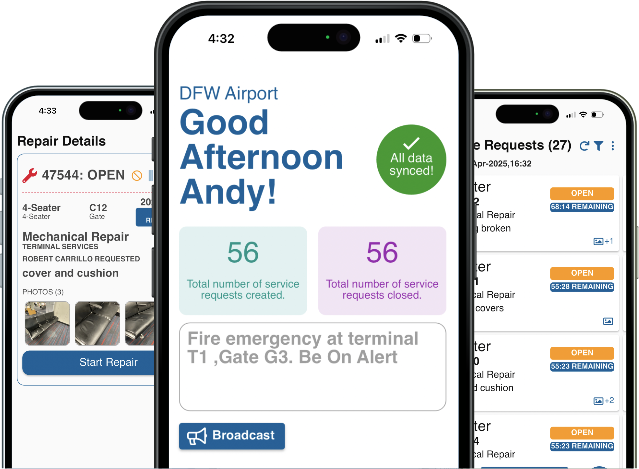
Recording inspections in real time against the individual asset creates a documented service history, supports lifecycle planning, and helps identify recurring or systemic issues. When repairs are needed, tying the work to the specific charging device and tracking it through completion provides the visibility needed to manage an expanding network of passenger technology.
As airports continue investing in additional charging infrastructure, it may be time for all of us to think beyond installation and begin planning for the long-term stewardship of these assets. After all, the goal isn’t simply to provide charging devices. It’s to ensure they continue delivering the passenger experience we intended when we installed them.
A Question for Airport Facility Leaders
As charging infrastructure continues to expand across our industry, are our maintenance strategies evolving at the same pace?

References
International Air Transport Association (IATA). Global Passenger Survey.
https://www.iata.org/en/publications/store/global-passenger-survey/
USB Implementers Forum (USB-IF). Universal Serial Bus 3.1 Legacy Connectors and Cable Assemblies Compliance Document, Revision 1.1, Section 3, Table 3-1 (Durability), p. 7.
https://www.usb.org/sites/default/files/CabConn_Legacy_3_1_Compliance_Rev_1_1.pdf
Other Resources




Ready to See ALINK™ In Action?
Discover how operational visibility can transform your facility’s performance.