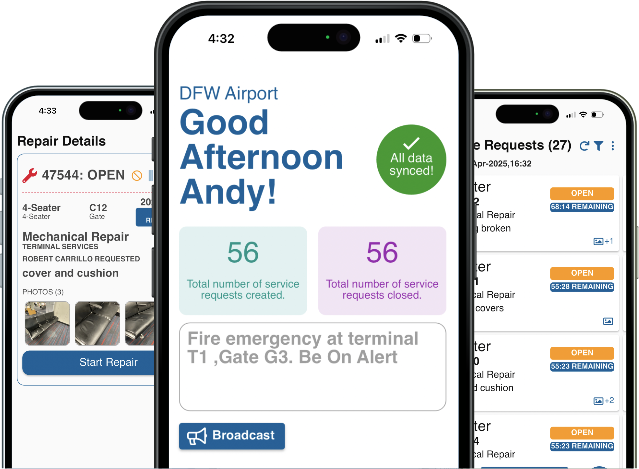
Simple for Frontline Teams.
Powerful for Operations Leaders.


"Their attention to detail and exceptional customer service provides invaluable support to furniture providers and the airport operator, while helping deliver an elevated passenger experience." – Susan Goodspeed, Global Head of Airports
What is ALINK™
ALINK™ is a real-time asset visibility and reporting platform built for complex, high-traffic environments. It connects frontline teams with operations leadership, ensuring high-touch assets are inspected, maintained, and addressed before issues impact safety, service, or experience. ALINK™ works alongside existing systems to close the visibility gap between what’s happening in the field and what leadership needs to know.
Everything You Need In One Platform

Real-Time Asset Visibility
Instant insight into asset status, condition, and activity across your facilities, fleets, or venues.

Simple Mobile Reporting
Frontline teams use our mobile app to capture issues in seconds using photos and notes, no paperwork or complex workflows.

Customizable & Real-Time Dashboards
Operations leaders see the priorities, trends, and performance they want to see – at a glance.

Automated Alerts & Notifications
The right teams are notified the moment an issue is reported, reducing response time and missed handoffs.

Closed Loop
At the moment a work order is closed – the reporting party is notified – closing the report/repair loop.

Digitized LOPAs
Digitized LOPAs make all of the information available via the mobile app.

Drop a Pin
Drop pins for hard to locate assets (like fire extinguishers) and be routed to the pin.

Works Across Teams & Locations
Operate across facility maintenance, operations and customer experience groups.

Crowd Sourced Issue Reporting Available
Turn on crowd sourced asset issue reporting, also featuring a closed loop approach.
Before and After
How ALINK™ Transforms Visibility
legacy-operations.exe
Without ALINK TM
Paper logs and manual checklists
Radio calls and fragmented communication
Delayed repairs and follow-ups
Limited accountability and incomplete records

alink-dashboard.app
With ALINK TM
Closed reporting loop
Centralized, real-time dashboards
Mobile reporting at the point of activity
Instant issue and repair request creation
Complete asset history and verified documentation
The difference is immediate: faster response, clearer
accountability, and greater confidence in daily
operations.
Not Just Another Maintenance Tool
By turning everyday operational activity into reliable data, ALINK™ helps organizations operate cleaner, faster, and smarter without adding headcount or complexity. ALINK™ is not a traditional CMMS or ticketing system. It is a frontline visibility platform designed to:
- Capture what’s actually happening in the field
- Standardize inspections and reporting
- Give leadership confidence in asset readiness and performance
Core Features
Everything You Need In One Platform
Mobile Issue Reporting
Frontline teams can report asset issues instantly using a simple mobile platform.
With a quick scan or tap, users can:
- Identify the asset and location
- Log issues in seconds
- Add photos or notes for clarity
- Trigger maintenance or cleaning workflows

Scan-to-Verify Inspections
ALINK™ standardizes inspection and cleaning activities across teams, shifts, and locations which creates reliable documentation without slowing down operations.
Teams can:
- Verify inspections in real time
- Confirm cleaning, maintenance, or readiness
- Capture consistent, timestamped records
- Drop a location pin for hard to locate assets

Asset Status & Visibility
ALINK™ provides clear, real-time insight into:
- Asset location, condition and readiness
- High-use and high-risk assets
- Recurring issues and performance trends

Real-Time Dashboards for Leadership
Supervisors and operations leaders access centralized dashboards that show:
- Open issues across facilities, routes, or venues
- Active maintenance and response activity
- Inspection and cleaning compliance trends over time

Frequently Asked Questions
What does Airline Fabricare Systems (AFS) do?
AFS helps airports and large facilities track, manage, and maintain high-contact, customer-facing assets using the ALINK™ platform.
We specialize in environments with thousands of distributed assets such as seating, charging units, kiosks, and interior fixtures—where asset condition directly impacts operational performance and customer experience.
By combining field execution with ALINK™, our mobile-first asset management platform, we transform everyday maintenance into structured, measurable performance data. This improves consistency, reduces response gaps, and lowers total cost of ownership.
Is AFS a software company, a service provider, or both?
AFS is both—by design.
We combine hands-on service execution with ALINK™, a mobile-first asset-specific asset management platform built for high-contact environments. Field teams capture audits, cleaning, repairs, and parts usage directly into the system, aligning operational work with centralized performance data.
Because the platform is asset-based rather than license-based, organizations can deploy it broadly which improves collaboration, forecasts accuracy, lifecycle planning, and customer experience management across departments.
When was AF Systems founded?
AFS was established in 2001 and has continuously evolved to support high-traffic, passenger-facing environments with structured asset care and visibility solutions.
What makes AFS different from traditional cleaning or facility service providers?
Most service providers measure success by whether a task was completed. AFS measures success by how each high-contact asset performs over time operationally, visually, and financially.
We manage public seating and other high-contact assets as long-term lifecycle investments. Through ALINK™, our asset-specific tracking platform, every seating unit or customer-facing fixture is uniquely identified and monitored for condition, service activity, repairs, parts usage, and cost history. This creates a true asset-level accountability rather than simple work-order confirmation.
Because ALINK™ is asset-based and not user-based, organizations can scale adoption across frontline teams, maintenance departments, and leadership without licensing limitations.
The result is extended asset life, improved warranty validation, smarter capital planning, and measurable environments in customer experience performance.
What makes ALINK™ unique?
ALINK™ is unique because it is purpose-built for public seating and high-contact passenger-facing assets and was built from the mobile interface backward.
Unlike generic CMMS systems that start with desktop reporting, ALINK™ was engineered for fast, real-world data capture during everyday interactions. Each asset is uniquely identified and tracked individually, supporting refurbishment decisions, warranty validation, manufacturer comparisons, replacement timing, and long-term capital planning.
Because it is asset-based rather than user-based, organizations can scale participation widely, strengthening data intelligence and improving both maintenance performance and customer experience outcomes.
What does “asset visibility” mean?
Asset visibility means having real-time knowledge of the location, condition, service history, and lifecycle cost of every public seating unit or passenger-facing asset within your operation.
Through ALINK™, assets are structured and assigned unique barcode or QR identifiers. Field teams capture audits, cleaning activity, repairs, parts consumption, and cost inputs directly at the point of contact. Over time, this builds a living performance profile for each asset.
This level of visibility reduces recurring issues, supports predictive maintenance strategies, informs refurbishment versus replacement decisions, and helps organizations evaluate seating manufacturers or future purchasing strategies based on measurable performance data.
What is ALINK™?
ALINK™ is AFS’s mobile-first, asset-specific asset management and visibility platform designed for high-contact, customer-facing environments.
It captures barcode or QR-based asset data in real time and tracks condition, service execution, repairs, parts usage, inventory, lifecycle cost, and performance trends. ALINK™ connects field-level activity with centralized oversight, giving organizations measurable control over asset reliability, presentation standards, and capital planning decisions.
Who uses ALINK™ within an organization?
ALINK™ is intentionally designed for broad operational participation. Users often include:
- Frontline employees
- Maintenance technicians
- Customer experience teams
- Operations managers
- Inventory and procurement teams
- Executive leadership
Because ALINK™ is priced on an asset basis and not a per-user license model, there is no cap on participation. Increased engagement strengthens data accuracy, trend visibility, forecasting precision, and performance accountability across departments.
What types of issues can ALINK™ track?
ALINK™ tracks virtually any issue related to public seating and high-contact, passenger-facing assets because it is structured around the individual asset, not just the work order.
Each asset is uniquely identified and configured with foundational data such as location, manufacturer, model, installation date, and bill of materials (BOM). From there, ALINK™ layers in operational intelligence over time, including:
- Condition-related issues (wear, damage, structural concerns)
- Preventative maintenance cycles and audit completion
- Cleaning frequency and compliance documentation
- Repair classifications and resolution timelines
- Parts usage, parts pricing and inventory movement
- Recurring defects patterns and high-wear trend zones
- Total cost of ownership per asset
Because every action is tied directly to a specific asset, organizations gain a continuously evolving performance record that supports root-cause analysis, warranty validation, manufacturer evaluation, and data-driven capital planning decisions.
How does AFS bring clarity and consistency to high-traffic environments?
High-traffic environments demand predictability. AFS delivers that by pairing standardized service protocols with real-time asset-level intelligence through ALINK™.
Each high-contact asset is digitally structured and uniquely identified, ensuring consistent documentation across facilities, fleets, or venues. Leadership dashboards provide centralized oversight into compliance rates, response times, recurring defects, and cost trends.
Standardized service protocols and defined maintenance intervals are reinforced through measurable tracking, not just policy. Dashboards provide centralized oversight across facilities, fleets, or regions allowing leadership to compare performance, identify recurring issues, and address variability before it impacts the guest experience.
Instead of relying on policy alone, organizations gain measurable oversight resulting in consistent asset reliability, presentation standards, and brand alignment across distributed operations.
How does ALINK™ eliminate asset visibility gaps?
Visibility gaps occur when asset issues go undocumented, service activity is inconsistently recorded, or data exists in silos.
ALINK™ eliminates those gaps by making asset-level reporting fast, intuitive, and mobile-first. Authorized users can scan a barcode or select an asset and log meaningful information in seconds. Each action is timestamped and tied directly to the asset’s record.
Dashboards update in real time, ensuring leadership sees condition changes, response times, compliance rates, and recurring issues immediately. The result is a closed-loop, transparent operational environment where public seating and other customer-facing assets are never unmanaged or invisible.
Can ALINK™ interface with existing facility or maintenance systems?
Yes. ALINK™ can operate as a standalone asset management system or integrate with an existing CMMS, ERP, or facility management platform.
In many organizations, ALINK™ serves as the mobile-first, barcode-level field data capture layer. Audits, issue reports, repairs, and condition updates are recorded in real time at the asset level. That structured data can then flow into the organization’s primary system of record, improving the quality, accuracy, and consistency of incoming maintenance data.
This approach enhances visibility into public seating and customer-facing assets without disrupting broader enterprise systems or workflows.
Can I track budgets using ALINK™?
Yes. ALINK™ integrates financial inputs directly into asset-level activity.
Parts pricing, quantities used, quantities purchased, and inventory levels are tracked in real time. Every repair or service action is tied to a specific asset, creating a live cost-of-ownership profile at both the asset and portfolio level.
This enables organizations to:
- Track spend against maintenance budgets
- Identify recurring cost drivers
- Compare repair vs. replacement thresholds
- Forecast capital requirements based on performance trends
Rather than treating budgeting as a separate reporting process, ALINK embeds financial visibility directly into daily asset management.
Can I track parts supplies and inventory?
Yes. ALINK™ provides structured, real-time inventory tracking tied directly to asset servicing.
As parts are used, they are recorded against the exact asset and automatically deducted from inventory. The platform tracks:
- Parts usage and consumption rates
- Purchase quantities and receiving logs
- Inventory levels by storeroom location
- Invoice uploads for financial audit trail
This integration reduces stockouts, improves reorder planning, strengthens cost control, and ensures the right materials are available to maintain uptime in high-demand environments.
Can I track multiple storehouse locations?
Yes. ALINK™ supports multiple storerooms across facilities, campuses, cities, or nationwide networks.
Inventory is tracked by individual location while remaining visible within one centralized system. When an audit identifies parts required for a seating unit or other asset, ALINK can reference inventory across locations and generate a precise pick list from the selected storeroom.
This allows teams to pre-stage materials for overnight aircraft service, rail car maintenance windows, or pre-event stadium preparation resulting in reducing downtime and eliminating guesswork.
How does AFS support seating refurbishment versus replacement decisions?
ALINK™ provides total cost-of-ownership visibility for each seating asset, including repair frequency, parts costs, labor inputs, and recurring issue patterns.
This allows leadership to determine when continued repair is financially justified and when refurbishment or replacement becomes the more strategic investment. These decisions can be made based on structured performance data rather than assumptions or isolated incidents.
Can AFS help evaluate seating manufacturers or future seating purchases?
Yes. Because ALINK™ tracks asset condition, recurring defects, parts usage, repair frequency, and total cost of ownership per seating unit, organizations gain objective performance data tied to specific manufacturers and models.
This data supports:
- Manufacturer performance comparisons
- Warranty validation
- Repair vs. replacement analysis
- Refurbishment decision modeling
- Smarter future seating procurement
Instead of relying on anecdotal feedback, organizations can evaluate seating investments based on measurable lifecycle performance.
Can AFS help extend the life of public seating assets?
Yes. AFS combines structured preventative maintenance programs with asset-level visibility through ALINK™ to protect and extend seating lifespan.
By identifying high-wear zones, tracking damage patterns, and proactively replacing components before failure, organizations reduce premature replacement costs and maintain consistent presentation standards. This extends usable life while improving customer perception and operational reliability.
What industries does Airline Fabricare Systems specialize in?
AFS specializes in high-traffic, passenger-facing environments where asset condition directly impacts perception and operational reliability, including:
- Airports
- Airlines
- Stadiums and large venues
- Rail and bus transit systems
- Theaters and public facilities
In each sector, we focus on high-contact assets that influence lifecycle cost, safety, uptime, and brand trust.
How does AFS support stadiums and large venues?
AFS supports stadiums and venues by structuring seating and customer-facing assets within ALINK™ by section, row, seat, suite, or hospitality area.
During events, teams can log audits, cleaning, and repairs in seconds using mobile devices which creates live visibility into asset readiness. Between events, ALINK™ highlights high-wear zones, recurring damage patterns, and parts consumption trends enabling preventative maintenance and protecting premium seating investments.
This approach strengthens operational readiness while preserving guest perception during high-visibility events.
How does AFS help airports improve asset tracking and issue resolution?
AFS delivers barcode-level asset tracking for airport seating and other passenger-facing infrastructure. Each asset in ALINK™ is digitally tied to specific gates, concourses, terminals, or baggage claim areas.
When an issue is observed, staff can scan the exact seating unit or asset and document details in seconds. Because each asset carries its specification profile and service history, technicians respond with precision and arrive prepared which results in reducing repeat visits and shortening resolution times.
Central dashboards then provide leadership with insights into high-wear zones, recurring issues, response performance, and cost drivers supporting better coordination and stronger customer experience outcomes.
Does AFS operate nationwide?
AFS ensures consistency by combining standardized service procedures with real-time asset-level visibility powered by ALINK™.
Assets across all facilities are uniquely identified and tracked within a centralized platform. Dashboards allow leadership to compare performance metrics by region, asset category, facility, or fleet making it ready to identify variability and correct it quickly.
What types of assets does AFS help organizations manage?
AFS specializes in managing public seating and other high-contact passenger-facing assets across aviation, transit, and venue environments. These include:
- Airport gate seating, terminal furniture, and lounge seating
- Stadium and theater seating (sections, suites, hospitality areas)
- Rail and bus seating systems and interior components
- Aircraft seat covers, cushions, textiles, and integrated features
- Charging stations and seat-based power components
- Waste receptacles, kiosks, and other customer-facing features
Through ALINK™ asset level tracking, each asset is mapped, uniquely identified, and continuously monitored for condition, service history, recurring issues, and total cost of ownership supporting maintenance performance and customer experience outcomes.
Does AFS specialize in public seating maintenance?
Yes. Public seating is a core focus of AFS.
We support airport gate seating, terminal seating, lounge furniture, stadium seating, theater seating, rail and bus seating systems, and aircraft seating components. These assets experience constant passenger contact and represent one of the most visible indicators of operational quality.
Through ALINK™, each seating unit is uniquely identified and tracked individually, enabling structured maintenance, lifecycle monitoring, and measurable performance management at the seat level.
- Arconas
- Flyaway
- Ascent
- Nova C
- Cluster
- Connex
- Hop Bench
- Surge Tower
- emBARq Media Table
- Zoeftig
- Zenky+
- Vitra
- Airline
- Meda Gate
- Grand Repos
- Petit Repos
- Soft Wait
- HAL Bar Stools
- Sit On It Seating
- Pasea Ottoman
- Pasea Table
- Kusch Co
- Lupino
- V Travel Round Sofa
- Volpe
- KI
- Hub
- MyWay
- Isle Power Tower
- Sandler Seating
- Lapse
- Teknion
- Hub Table
Ready to See ALINK™ In Action?
Discover how operational visibility can transform your facility’s performance.